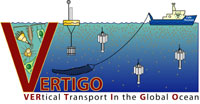
VERTIGO
VERtical Transport In the Global Ocean
Project Description
The main goal of VERTIGO is the investigation of the mechanisms that
control the efficiency of particle transport through the mesopelagic
portion of the water column.
Question: What controls the
efficiency of
particle transport between the surface and deep ocean? More
specifically, what is the fate of sinking particles leaving the upper
ocean and what factors influence remineralization length scales for
different sinking particle classes? VERTIGO researchers have set out to
test two
basic hypotheses regarding remineralization control, namely: 1.
particle source characteristics are the dominant control on the
efficiency of particle transport; and/or that 2. mid-water processing,
either by zooplankton or bacteria, controls transport efficiency. To
test their hypotheses, they will conduct process studies in the field
focused on particle flux and composition changes in the upper 500-1000m
of the ocean. The basic approach is to examine changes in particle
composition and flux with depth within a given source region using a
combination of approaches, many of which are new to the field. These
include neutrally buoyant sediment traps, particle pumps, settling
columns and respiration chambers, along with the development of new
biological and geochemical tools for an integrated biogeochemical
assessment of the biological pump. Three week process study cruises
have been planned at two sites - the Hawaii Ocean Time-series site
(HOT)
and a new moored time-series site in the subarctic NW Pacific (Japanese
site K2; 47oN 160oE) - where there are strong contrasts in rates of
production, export, particle composition and expected remineralization
length scales.
Evidence for variability in the flux vs. depth relationship of sinking
particles is not in dispute but the controls on particle transport
efficiency through the twilight zone remain poorly understood. A lack of
reliable flux and particle characterization data within the twilight
zone has hampered our ability to make progress in this area, and no
single approach is likely to resolve these issues. The proposed study will apply quantitative
modeling to determine the net effects of the individual particle
processes on the effective transport of carbon and other elements, and
to place the shipboard observations in the context of spatial and
temporal variations in these processes. For rapid progress in this
area, we have organized this effort as a group proposal taking
advantage of expertise in the US and international community.
The efficiency of particle transport is important for an accurate
assessment of the ocean C sink. Globally, the magnitude and efficiency
of the biological pump will in part modulate levels of atmospheric CO2.
We maintain that to understand present day ocean C sequestration and to
evaluate potential strategies for enhancing sequestration, we need to
assess possible changes in the efficiency of particle transport due to
climate variability or via purposeful manipulations of C uptake, such
as via iron fertilization.
Lead Principal Investigator
Ken Buesseler (Woods Hole Oceanographic Institution)
Participating Investigators and Institutions
List of VERTIGO investigators from the » Cafe Thorium Web site
Project Proposal
original proposal abstract (PDF format)
Project Web Site
at WHOI: » VERTIGO Project Web site
Project Data and Results
Final Database: access to online relational database of
final data
VERTIGO web site: online archive of original project cruise data (restricted access)